A Human-in-the-Loop Content Moderation Agent Built on Liferay Workflow and Gemini
This is LR Tools’ rewrite of a post by Ankit Srivastava on Liferay.dev describing a proof-of-concept for smarter, faster content moderation built on tools already inside Liferay.
The human bottleneck
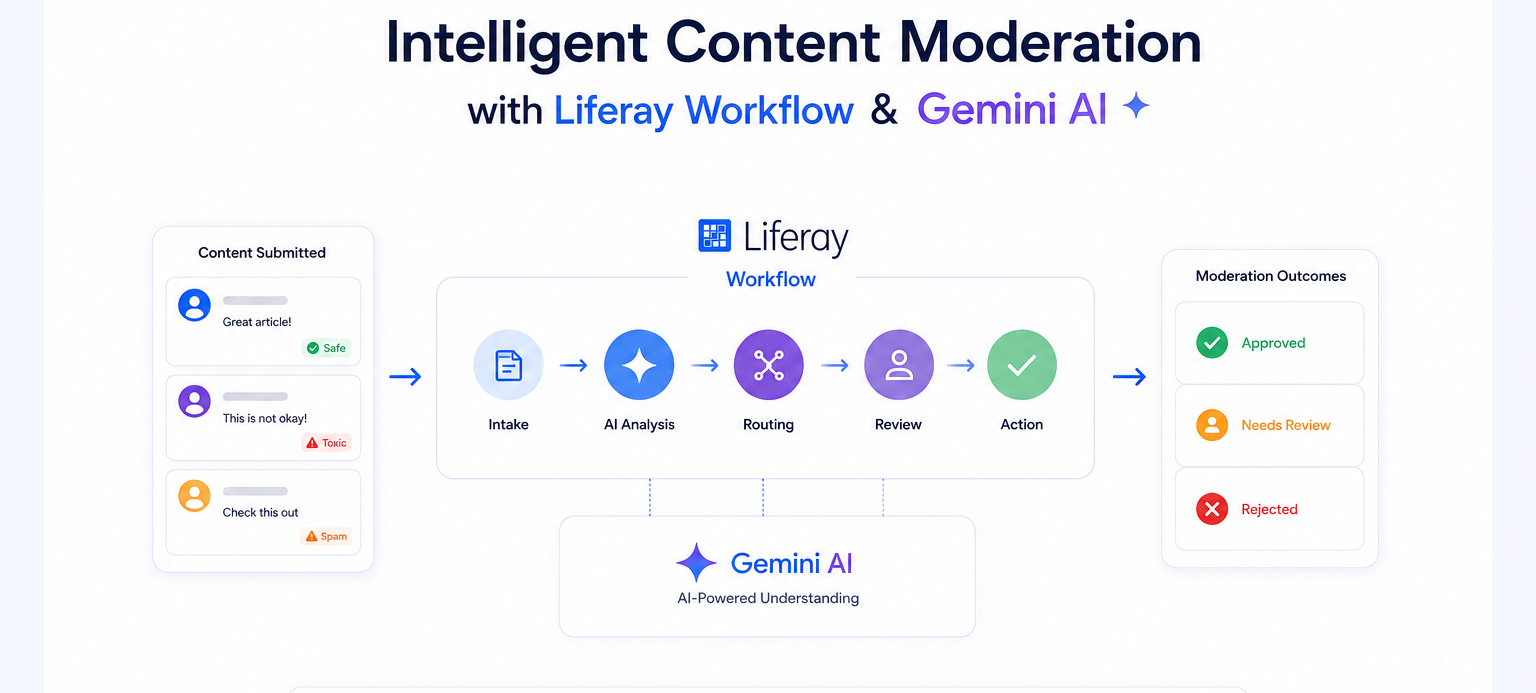
Any active online community faces the same tension: you want free-flowing discussion, but you also need to keep spam, toxicity, and bad-faith posts out. The traditional fix — a human moderator reading every comment before it goes live — doesn’t scale. It’s slow, expensive, and genuinely exhausting for whoever’s doing it.
A smart gatekeeper, not a replacement
The approach here pairs two things Liferay already has: the Kaleo Workflow engine, and Google’s Gemini 2.5 Flash as the reasoning layer. The explicit design goal is augmentation, not automation for its own sake — the AI shouldn’t be making moderation decisions instead of a human, it should make the human’s job faster. The target behavior for the agent breaks down into three things: read what a comment is actually trying to say, flag anything suspicious with a concrete reason attached, and — critically — tell the difference between a frustrated user and a genuinely toxic one.
The stack
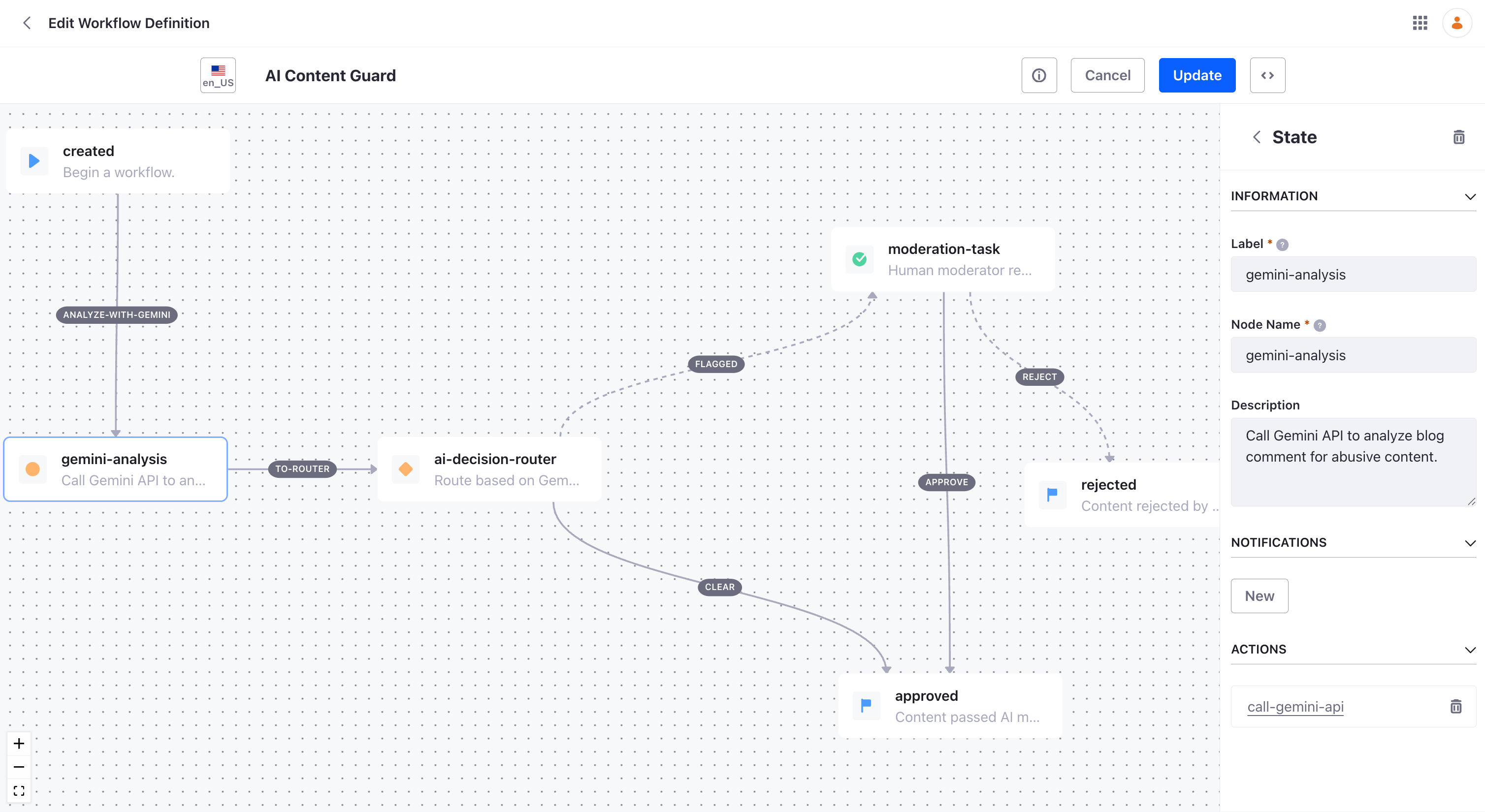
Three pieces do the work: a Liferay workflow definition in XML lays out the state machine a submitted comment moves through on its way to “Approved”; Groovy scripting sits in the workflow as the integration layer that reaches out to external services; and the Gemini API does the actual sentiment and intent analysis.
The test that actually mattered: sarcasm
Testing against obvious spam is easy — the interesting test is sarcasm. The example used: a comment reading something like “Oh, perfect. I love it when the button deletes my data. Truly a 10/10 experience.” A naive keyword filter keys off “love” and “10/10” and waves it straight through. Gemini instead read the irony correctly, recognized the underlying complaint about a data-destroying bug, and flagged the comment for human review instead of auto-approving it — exactly the distinction a keyword-based filter can’t make.
What changes for the moderator
Instead of opening a bare, context-free submission, moderators now see an AI-authored annotation attached to flagged items — something like “AI Flagged: Potential hostile sarcasm directed at the author.” The system keeps the speed of automated triage, while the actual judgment call — the part that needs empathy and context — still rests with a person. That’s the human-in-the-loop model the whole design is built around.
Where this goes next
The current build is explicitly a proof of concept, relying on Liferay Workflow Scripting (Groovy) to bridge comments and the Gemini API. Two changes are already planned: routing the LLM configuration through Liferay AI Hub instead of hand-rolling REST calls and managing API keys inside Groovy scripts, for cleaner and more secure management of AI usage across the portal; and moving the moderation logic out of in-JVM scripting entirely into a Client Extension — a separate microservice, in whatever language fits, that should be more resilient, easier to unit test, and easier to upgrade than logic embedded in a workflow script.
The intent behind both changes is the same: keep the workflow low-code for whoever’s designing it, while making the system underneath it high-performance from an administrator’s point of view.
This article is LR Tools’ rewrite of the original post by Ankit Srivastava — read it on Liferay.dev for the author’s own framing.
Este artículo está adaptado de: Ankit Srivastava, Liferay.dev