A First Look at Liferay's AI Content Site Generator
This is LR Tools’ rewrite of an early hands-on look by David H Nebinger on Liferay.dev at a capability being built into Liferay AI Hub.

Past content generation, into site construction
Most enterprise AI conversation up to this point has centered on content generation — chatbots, summaries, writing assistants. Useful, but all of it still leaves the actual construction of a digital experience to a human. The capability covered here, built around Liferay AI Hub and referred to as the Content Site Generator, points somewhere different: AI-assisted site creation, not just AI-generated text. The goal isn’t replacing developers or designers — it’s compressing the distance between an idea and a working experience.
Starting from one prompt
The flow begins with a single natural-language prompt. The example used described a small site about “vibe coding” — shipping software with AI as a coding partner — specifying three pages: a Home page (hero with tagline, an About section, a featured-posts strip pulled from the blog), a Manifesto page (a longer essay on what vibe coding actually changes about daily developer workflow), and a Blog (posts where engineers share AI workflows, favorite prompts, and shipping stories), plus a simple top nav, a footer, and a requirement to use AI/tech-themed imagery throughout.
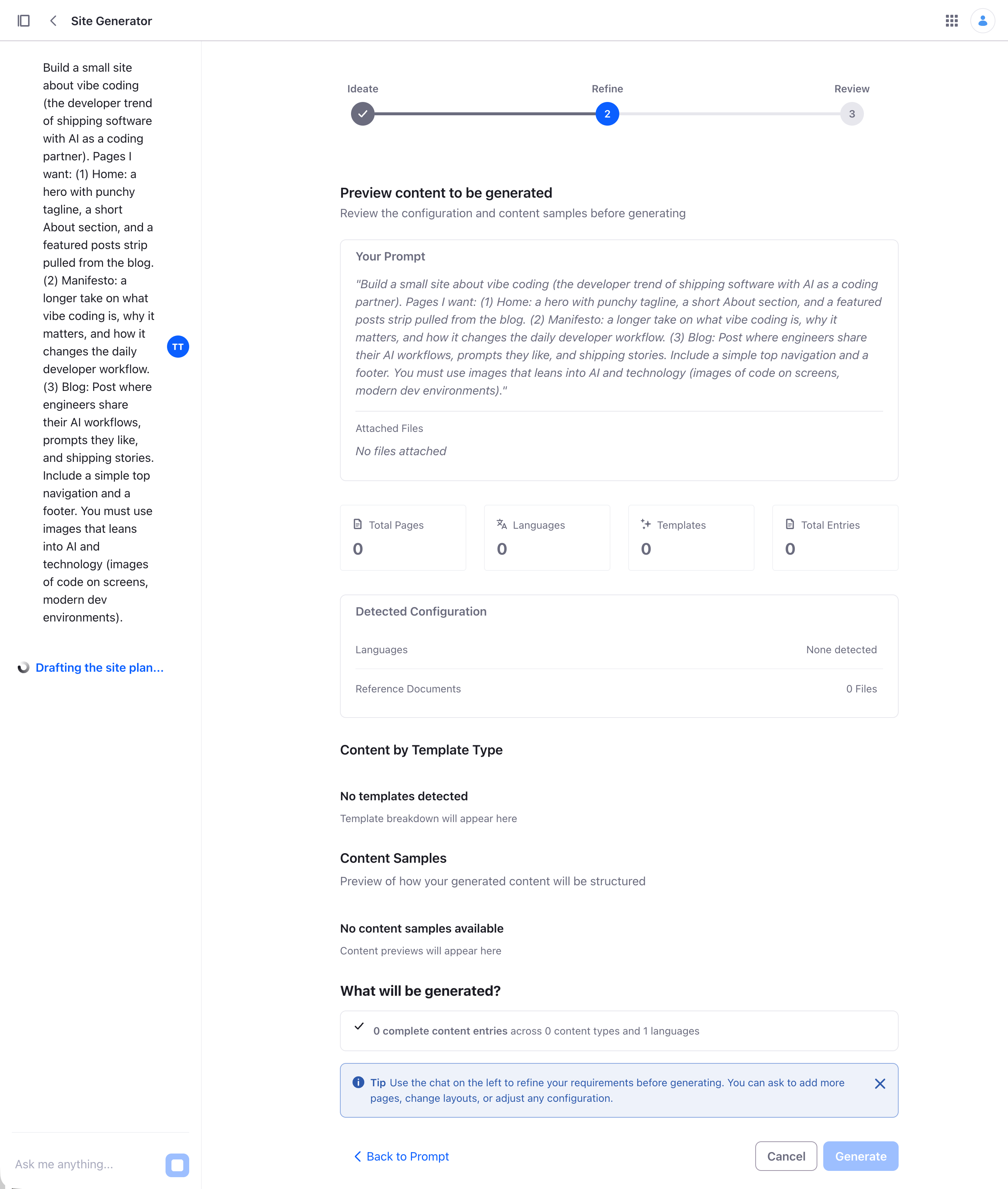
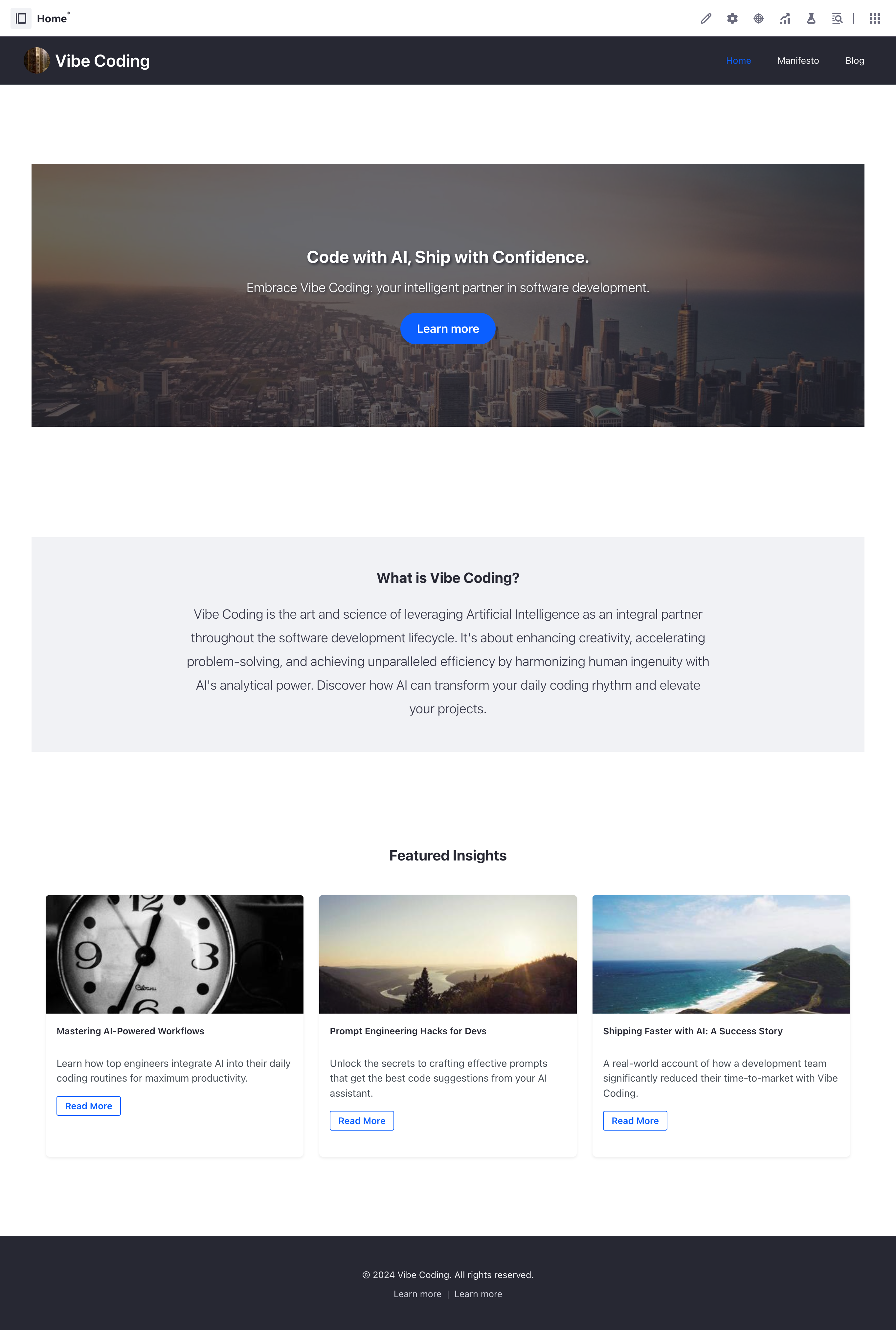
From that single prompt, the system plans the site: it works out what assets it needs, generates content, generates imagery, assembles layouts, builds the pages, and produces a full working site. What stands out isn’t that content got generated — it’s that structure did: navigation, layout decisions, imagery, reusable components, and content relationships across a multi-page experience, not a single one-off landing page.
It’s still built like a Liferay site
The important implementation detail is what the output is actually made of: standard out-of-the-box fragments, newly generated fragments where needed, standard page composition, and components that are Style Book–compatible. Because the result respects Style Books, the generated site can be fully restyled afterward without rewriting generated code or manually rebuilding pages — it stays part of the platform’s design system instead of becoming a disconnected artifact that only the AI understands. That’s the architecturally significant choice here: AI accelerates composition, it doesn’t bypass the platform underneath it.
Editing by describing intent
Generation isn’t a one-shot event, either. Inside the page editor, further edits can be made with natural-language prompts — the example given is “Add a 3 column grid at the bottom with cards for the latest blogs.” Instead of manually building a container, configuring the layout, dropping in fragments, and wiring up content, the AI performs the operation directly. That shifts what editing feels like: describing the intended result matters more than manually executing the mechanics of getting there.
Why this matters more than a bolted-on AI feature
What makes this feel different from an isolated AI tool stapled onto a platform is that it preserves the things enterprises actually need alongside the speed: governance, reusable components, centralized styling, structured content, editable experiences, and composable architecture. Fast generation on its own isn’t the hard part — generating something that stays maintainable afterward is, and that’s the part this approach is explicitly built around.
Still early
This is a first look at something still evolving, not a finished feature. What it already signals is a direction: faster experience creation, AI-assisted composition, prompt-driven editing, intelligent asset generation, and tight integration with the platform’s existing architecture rather than a workaround built next to it.
This article is LR Tools’ rewrite of the original post by David H Nebinger — read it on Liferay.dev for the author’s own framing.
Dieser Artikel ist adaptiert von: David H Nebinger, Liferay.dev